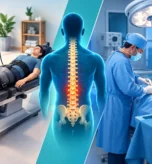
A painful back or neck can make a normal workday, a drive through Farmington, or a weekend workout feel much bigger than it should. When symptoms keep returning, many people begin comparing spinal decompression versus surgery and wondering whether conservative care is enough. The right answer depends on the cause of your symptoms, the severity of nerve involvement, your functional limitations, and how your condition responds to a carefully guided treatment plan.
The goal is not to delay necessary medical care or to rush into an invasive procedure. It is to identify the safest, most appropriate path to relieve pain, restore movement, and protect your long-term function.
Spinal Decompression Versus Surgery: Start With the Diagnosis
“Decompression” can describe two very different approaches. Non-surgical spinal decompression is a conservative therapy that uses controlled, gentle traction to reduce pressure through segments of the spine. It may be used as part of a broader plan that includes chiropractic care, mobility work, soft-tissue treatment, and rehabilitation exercise.
Surgical decompression is an operation intended to create more space for compressed nerves or the spinal cord. Depending on the diagnosis, a surgeon may remove part of a herniated disc, bone spur, or thickened tissue. Procedures can include discectomy, laminectomy, or other approaches, sometimes with fusion when stability is a concern.
Because the same word is used for both, it is easy to assume they are interchangeable. They are not. Non-surgical decompression does not repair every structural problem, and surgery is not automatically the best first option for every disc bulge, episode of sciatica, or case of spinal stenosis.
A quality evaluation matters before choosing either route. Your provider should consider your medical history, physical examination findings, pain pattern, strength, sensation, reflexes, movement tolerance, and any imaging that is clinically appropriate. An MRI can show changes in the spine, but images alone do not determine treatment. Many adults have disc changes on imaging without symptoms, while another person with a less dramatic scan may have significant functional limitations.
When Non-Surgical Decompression May Be Considered
Non-surgical spinal decompression may be appropriate for some people with mechanical low back or neck pain, disc-related symptoms, radiating pain, or stiffness that limits daily activities. The treatment uses a series of controlled traction and relaxation cycles. The intent is to reduce loading through targeted spinal segments and help patients move with less irritation.
For the right patient, it can be a comfortable, nonpharmacological option within an individualized plan. It is generally not a one-treatment solution. Progress often comes from combining passive care with active rehabilitation: improving trunk and hip strength, restoring mobility, practicing better movement strategies, and gradually returning to meaningful activities.
This approach may be particularly helpful when symptoms are present but stable, neurological findings are not worsening, and the patient can participate in rehabilitation. For example, an office worker with recurring low back pain and intermittent leg discomfort may benefit from a structured conservative plan before considering invasive options. A commercial driver whose symptoms worsen with prolonged sitting may need both symptom relief and a practical program for posture, breaks, core endurance, and lifting mechanics.
Results vary. Non-surgical decompression is not suitable for everyone, and it should never be presented as a substitute for an appropriate surgical consultation when serious nerve compression or spinal instability is suspected.
What conservative care can and cannot do
Conservative care can help reduce pain, improve tolerance for movement, and support a return to work, sport, and daily tasks. It may also help some patients avoid unnecessary procedures when their symptoms improve with time and active rehabilitation.
It cannot reliably correct every cause of nerve compression. A large disc herniation with progressive weakness, severe spinal canal narrowing, fracture, infection, tumor, or significant instability requires medical assessment beyond routine conservative care. Honest treatment recommendations should make room for those distinctions.
When Surgery May Be the Better Choice
Surgery may be recommended when a clear structural issue is causing significant neurological compromise or when well-managed conservative treatment has not provided sufficient relief and function remains substantially limited. The decision is usually strongest when symptoms, examination findings, and imaging point to the same problem.
For some patients, surgery can relieve persistent leg or arm pain caused by a compressed nerve more quickly than continued non-surgical care. It may also be essential when there is a risk of permanent neurological damage. Surgical care has helped many people return to activities that pain and weakness had taken away.
Still, surgery involves trade-offs. Recovery can require time away from work and activity. Risks may include infection, bleeding, blood clots, anesthesia complications, persistent symptoms, scar tissue, or the need for additional treatment. Fusion procedures can also change how forces move through nearby spinal segments. Outcomes are often better when the surgical target is clear and the procedure matches the patient’s symptoms and goals.
A surgery consultation is not a failure of conservative care. It is one part of coordinated care when the clinical picture calls for it. Patients deserve straightforward information about expected benefits, alternatives, recovery demands, and realistic limits.
Red Flags That Need Prompt Medical Attention
Back and neck pain are common, but certain symptoms should not be managed by waiting to see whether they improve. Seek urgent medical evaluation for new loss of bowel or bladder control, numbness in the groin or saddle area, rapidly worsening weakness, major difficulty walking, loss of coordination, or severe pain after significant trauma.
Prompt assessment is also important for pain associated with fever, unexplained weight loss, a history of cancer, immune suppression, intravenous drug use, or severe unrelenting night pain. These symptoms do not automatically mean a serious condition is present, but they require medical evaluation to rule out causes that need urgent treatment.
How to Make the Decision With Confidence
The most useful question is not simply, “Can I avoid surgery?” It is, “What approach gives me the best chance to safely regain function?” For many people, a time-limited trial of individualized conservative care is reasonable. The plan should have clear goals, such as walking farther, sleeping better, sitting longer, lifting safely, or reducing radiating pain.
Reassessment should be built into that plan. If symptoms are worsening, weakness develops, or meaningful functional progress does not occur, the next step may be advanced imaging, a specialist opinion, or a surgical consultation. Good care adapts to the patient rather than forcing every condition into the same treatment model.
At Farmington HealthCare and Chiropractic, conservative treatment is approached as part of a coordinated clinical process. When chiropractic care, spinal decompression, rehabilitation, or other non-surgical options are appropriate, the focus is on measurable progress and active recovery. When specialist care is needed, collaboration with orthopedic, neurology, physiatry, and primary care partners helps patients move forward with clarity.
Questions Worth Asking at Your Appointment
Ask what diagnosis best explains your symptoms, whether there are signs of nerve damage, and what findings would change the treatment recommendation. You can also ask how long a conservative trial should last, what improvement should look like, and what activities are safe while you recover.
If surgery is being considered, ask what specific problem the procedure is intended to address, what happens if you wait, what rehabilitation will involve, and whether a second opinion would be useful. Clear answers support an informed decision rather than one made from fear or frustration.
Pain can make every option feel urgent. A careful evaluation, honest discussion of your goals, and a plan that monitors your progress can help you choose the next step with greater confidence and keep the focus where it belongs: getting back to the life and movement that matter to you.